In this article
- How Dubbing Works in Madrid
- Before You Enroll: Spanish, Diction and Certificates
- What You Practice in Class
- How to Compare Dubbing Schools in Madrid
- Dubbing Schools
- Escuela de Doblaje de Madrid (EDM)
- AM Escuela
- Svozarte
- Escuela de Doblaje y Oratoria Fernando Acaso
- A Working Studio That Teaches
- Soundub Formación
- Voice and Audiovisual Schools With Dubbing Courses
- Aula 51
- Escuela CES
- Online Options
- After Training: Your Demo and the Industry
- Frequently asked questions
- Do I need to speak Spanish to study at dubbing schools in Madrid?
- Do I need acting experience?
- Are there dubbing classes for kids in Madrid?
- Can I study dubbing online from another country?
- Do dubbing schools in Madrid award an official degree?
Quick answer: Dubbing schools in Madrid train you at the atril, the stand where you read and record lines to match the screen. Most classes run in rooms with a sound engineer, and everything happens in Spanish. Beginners can start in small groups at AM Escuela or Svozarte, while Soundub Formación and CES offer longer programs.
Madrid is one of the two big dubbing hubs in Spain, together with Barcelona. So if you speak Spanish and want to voice films, series or games for Spanish audiences, this is a natural place to train. The catch is that dubbing schools in Madrid vary a lot, from one-day workshops to programs that fill a whole school year.
This guide is for actors reading from outside Spain, including Latin Americans and bilingual performers. We checked every school on its official site in November 2026 and grouped them by type. We left out prices and start dates because they change every term, so check each school’s page for the next course.
How Dubbing Works in Madrid
Madrid dubs for Spain, in the Spanish spoken there (castellano). Latin American dubbing uses a separate “neutral Spanish” version, and its industry sits mainly in Mexico City, Buenos Aires and Miami. That is how the blog of the Escuela de Doblaje de Madrid explains it in a post on neutral Spanish.
The same blog reports that Madrid and Barcelona handle most of Spain’s dubbing work. In January 2026, Barcelona matched Madrid’s pay scales, and the two cities then started to prepare a joint collective agreement. That January 2026 post describes it as a first step toward a national agreement.
Madrid’s dubbing artists have their own union, ADOMA, which represents actors, directors and script adapters. It says it has signed three collective agreements, and it publishes the current one on its site. In April 2026, its members renamed it “Artistas de Doblaje en el Medio Audiovisual” and made it national, according to a notice in the BOE, Spain’s official gazette.
Geography helps too. Soundub Formación places its school in the Julián Camarillo area of San Blas, which its site describes as close to Madrid’s main dubbing and sound studios.
Before You Enroll: Spanish, Diction and Certificates
Every class below runs in Spanish, so fluent speech and clean diction come first. AM Escuela, for example, asks beginners for correct diction and fluent reading. Soundub also runs a diction test before its long course, and CES asks for ESO, Spain’s compulsory secondary certificate, plus a minimum age of 16.
Also, expect a school certificate rather than an official degree. Soundub Formación and Aula 51 both state that their training is non-regulated (formación no reglada). Meanwhile, CES and Soundub’s specialization course grant their own certificates. If a course promises an official title, ask which one and who issues it.
What You Practice in Class
Dubbing is acting with your voice, timed to someone else’s performance on screen. That is why every school in this guide trains acting, not just voice. In class, you read a take (a short chunk of script), listen to the original and record it at the atril while a teacher directs.
- Sync. At AM Escuela, beginners work without timecode and watch the scene closely. Then Svozarte’s intermediate level adds timecode and fewer rehearsal passes.
- Script adaptation. Spanish schools call it ajuste: reshaping the translated line so it fits the actor’s mouth. CES teaches it as part of its program.
- Acting at the mic. Soundub calls it applied interpretation, which means reproducing the performance of the actor you dub.
- Voiceover. Most schools add commercials, documentaries or audiobooks, because these jobs sit close to dubbing.
- Voice care. CES starts with breathing, phonation and diction. EDM also added a voice specialist (foniatra) who offers one-on-one vocal training.
While you compare schools, keep your voice in shape with our vocal warm-ups. For the bigger picture, our guide on how to become a voice actor covers training, demos and scams.
How to Compare Dubbing Schools in Madrid
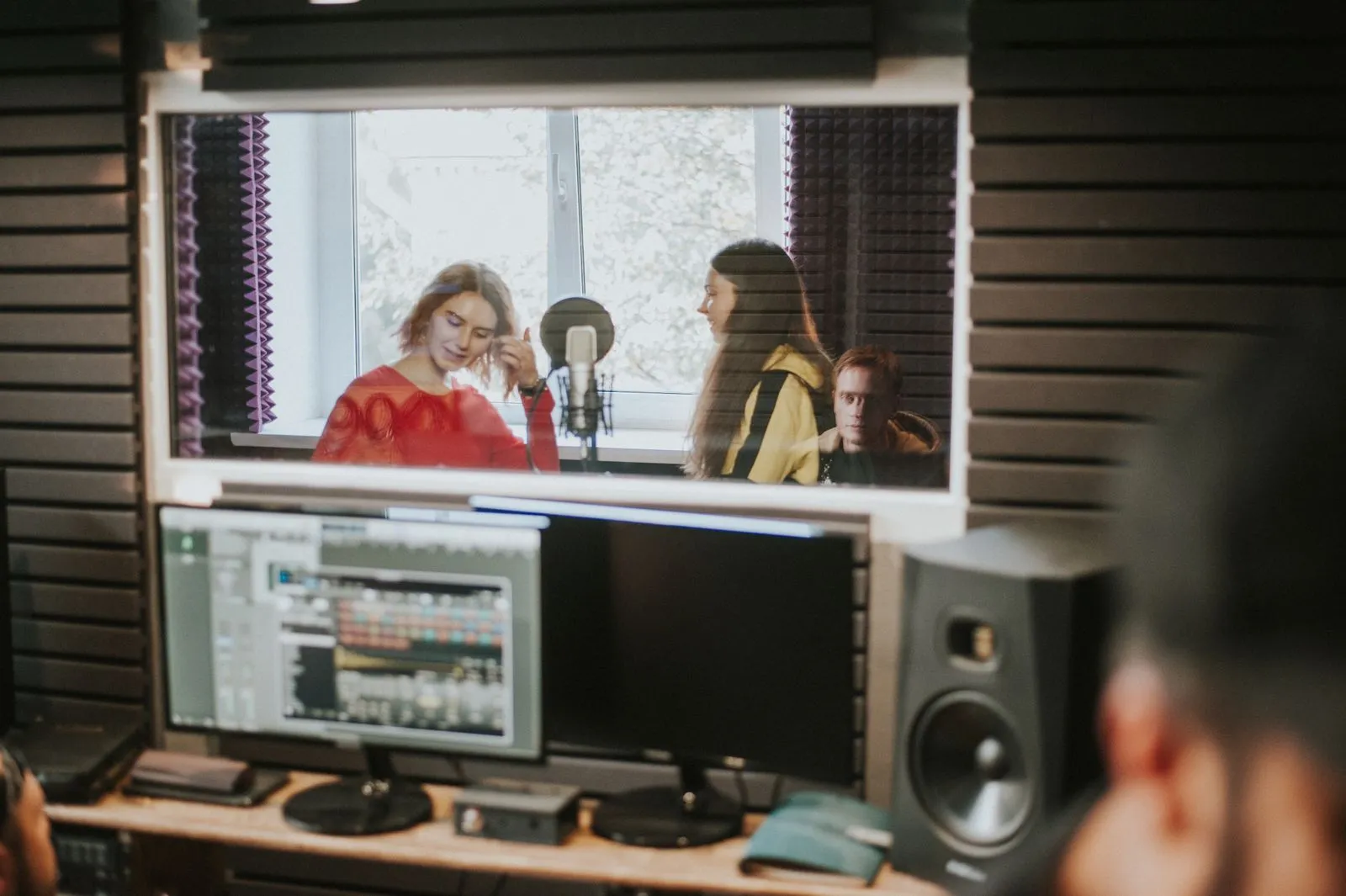
First, ask where you will record. Soundub Formación teaches in professional dubbing rooms with an engineer from the first class. CES, instead, uses soundproof rooms that simulate a studio.
Next, ask about group size, because fewer people means more turns at the atril. AM Escuela’s beginner groups hold 3 to 6 students, and Svozarte caps its beginner and intermediate groups at 4. Aula 51’s yearly course, by contrast, takes 6 to 10.
Then ask whether you leave with a demo. CES ends with your own sample, one dubbing take and two radio spots, and Svozarte records and mixes demos separately. Finally, check the format. Most of the offer is in person, and AM Escuela, for example, keeps its online classes for voiceover and vocal technique.
If you are also weighing general voice training, our list of voice acting classes explains what to look for in a teacher.
Dubbing Schools
These four dubbing schools in Madrid focus on dubbing and voiceover, with teachers who work in the industry.
Escuela de Doblaje de Madrid (EDM)
EDM says its teachers are working dubbing actors and directors, and its director, Lorenzo Beteta, is a dubbing actor and director himself. It works in small groups and has four professional recording rooms. Besides dubbing, it teaches video game dubbing (about four months), acting, singing, commercial voiceover and audiobook narration.
For young performers, it runs two dubbing groups, ages 8 to 12 and 13 to 18. It also gives private lessons to working actors who need dubbing technique, for example to dub themselves. The school is on Paseo del General Martínez Campos. See its course list.
AM Escuela
AM Escuela started in Madrid about 20 years ago and now also has branches in Valencia and Logroño. In Madrid, it teaches dubbing at three levels, plus kids’ dubbing, song dubbing, voiceover, vocal technique and singing. It also runs workshops on video games, verse and audio drama, and it has three soundproof rooms with Pro Tools.
The beginner level is for people who have never dubbed. Each class works like a studio session, with an engineer in the room and the teacher acting as director. You can join at any point in the year, and you move up after a level test. Kids 8 to 13 have their own workshop in groups of 3 or 4. The school is on Calle María Teresa; see its Madrid page.
Svozarte
Dubbing actor Jesús Pinillos directs Svozarte, a school in San Blas-Canillejas. Its standout feature is size: beginner and intermediate groups top out at 4 people, and the premium levels at 2. Beginners learn how a take works and how the studio runs. Then the intermediate level adds timecode and shorter rehearsals.
At the advanced level, you rehearse a scene three times at most, as in professional sessions. The school also explains how to enter the profession, how the agreements work and how to prepare a demo for directors. It records voice demos as well and offers two-hour private lessons. See the Svozarte courses page.
Escuela de Doblaje y Oratoria Fernando Acaso
Fernando Acaso’s school, on Calle Finisterre, teaches voiceover, acting and dubbing, plus public speaking. Its yearly Madrid course meets once a week for two hours, with up to 8 students, and there is also an intensive. If you prefer to start remotely, it offers an online program that begins with setting up a home studio. See its in-person courses.
A Working Studio That Teaches
Soundub Formación
Soundub Formación is also an active dubbing studio, so classes take place in its four professional dubbing rooms, with an engineer from the first session. It is on Calle Rufino González, about 500 meters from the Suanzes metro stop. Its dubbing certificate runs from a preliminary level for total beginners to a professional level, in groups of 3 to 6. Enrollment stays open all year, and students visit other studios to watch their teachers at work.
For a full school year, Soundub offers a 270-hour specialization course with a diction test and groups of 4 to 6. That certificate is the school’s own. It also teaches kids from 6 to 13 and briefs parents on the rules that protect minors who work in the arts. See the Soundub dubbing certificate.
Voice and Audiovisual Schools With Dubbing Courses
Two more schools in Madrid teach dubbing inside a wider voice or audiovisual program.
Aula 51
Aula 51, on Calle Alcalá in the Ventas area, splits its offer into voiceover, dubbing and communication, both in person and online. Its dubbing course is steady practice at the atril, in groups of 6 to 8. The school recommends at least three months, and it lists no prerequisites, although it suggests some basic knowledge helps.
For a broader path, its yearly voiceover and dubbing course meets four hours a week, with 6 to 10 students. It covers lip sync for dubbing, visual sync for video games and many kinds of voiceover. To join, you first take the one-day basic workshop, which lasts nine hours in a professional studio. See the Aula 51 dubbing course.
Escuela CES
CES is an image and sound school in the Hortaleza district, on Calle Mar Adriático. Its dubbing specialization lasts 210 hours. The program moves from vocal technique to acting with the voice, sync, script adaptation and how a dubbing room works. It also includes practice with commercials and radio spots.
You need ESO and to be over 16, but no prior experience. At the end, you leave with your own sample, one dubbing take and two radio spots, plus a certificate from the school. See the CES dubbing course.
Online Options
Most dubbing schools in Madrid teach in person, and dubbing itself happens in a recording room. So treat online study as a starting point or a supplement. Fernando Acaso’s online voiceover and dubbing program starts with a home studio setup and then moves to dubbing scenes and voiceover scripts.
Treintaycinco mm, a training company with offices in Madrid and Barcelona, runs a blended dubbing course. It combines 800 online hours, up to 24 months to finish and 80 hours of optional in-person workshops in recording studios. It includes a tool to rehearse at home, and the certificate is the company’s own. Before you sign up for any remote course, ask how many hours you will record with a director.
After Training: Your Demo and the Industry
A course does not guarantee work. EDM is candid about this in its school overview: it writes that dubbing has the same demand as any other profession, and that each person must then find their own way.
Your main tool will be a demo with short scenes and contrasting characters. Some schools help you build it: CES includes a take and two spots, and Svozarte records demos and teaches how to present them to directors. At Soundub, studio visits also let you see real sessions up close.
Once you work in the field, ADOMA keeps a voice bank where members post demos for studios, agencies and casting directors. The union also promotes a contract clause that bars using your recorded voice to train artificial intelligence, so read every contract before you sign. Above all, never pay for a promised job. Our guide on how to spot a fake casting call lists the warning signs.
For next steps, read about voice acting jobs and how to get auditions in Spain, and browse casting calls in Madrid. To compare cities, see our guides to dubbing schools in Barcelona and in Mexico. For broader stage and screen training, there is also our list of acting schools in Spain.
Frequently asked questions
Do I need to speak Spanish to study at dubbing schools in Madrid?
Yes, and fluently. Every course in this guide runs in Spanish, and some schools check diction before you start. AM Escuela asks for correct diction and fluent reading, and Soundub tests diction before its long course.
Do I need acting experience?
For beginner courses, usually not. AM Escuela’s first level is for people who have never dubbed, CES asks for no prior experience, and Soundub’s preliminary level takes total beginners. Some longer programs, however, ask for a basic workshop first, as Aula 51 does.
Are there dubbing classes for kids in Madrid?
Yes. EDM has groups for ages 8 to 12 and 13 to 18, AM Escuela runs a workshop for ages 8 to 13 and Soundub teaches kids from 6 to 13. Before any audition, read our guide to auditions for kids and teens.
Can I study dubbing online from another country?
You can start online with Fernando Acaso’s program or the blended course from Treintaycinco mm. Still, dubbing training happens in the booth, and most schools in this guide teach dubbing in person.
Do dubbing schools in Madrid award an official degree?
None of the schools we checked offers an official Spanish degree. Soundub Formación and Aula 51 describe their training as non-regulated, and CES, Soundub’s specialization and Treintaycinco mm grant their own certificates.
Reviewed in November 2026.
Books to go deeper
-
Building a Character
Konstantin Stanislavski The second half of the system: how inner work turns into body, voice, tempo and characterization. See it on Amazon -
A Challenge for the Actor
Uta Hagen Hands-on exercises for being present on stage (objectives, given circumstances, substitution) from one of New York's great teachers. See it on Amazon -
An Actor Prepares
Konstantin Stanislavski The foundation of the system: building a character from inner truth, imagination and emotion memory. Most acting schools start here. See it on Amazon
Each book takes you to Buscalibre or Amazon, depending on your country. Some of these are affiliate links: if you buy through them, Casting and Acting may earn a commission at no extra cost to you. As an Amazon Associate, Casting and Acting earns from qualifying purchases.
What did you think?


Comments
Join the conversation
Create a free account or log in to comment and earn +15 XP.